
<p>You started a GLP-1 to lose fat. Nobody warned you that without a plan, up to 40% of what you lose can be muscle.</p>
<p>Here's the uncomfortable math: your appetite dropped 70%, but your protein requirement went <em>up</em>. Most people on semaglutide or tirzepatide are eating half the protein their body needs to protect lean mass — and they don't find out until the scale stops moving and the mirror starts looking softer instead of tighter.</p>
<p>This is fixable. But not with willpower.</p>
<h2>The Protein Target Your Doctor Probably Didn't Mention</h2>
<p>During active weight loss, research consistently points to <strong>1.0 to 1.2 grams of protein per kilogram of body weight</strong> — not the outdated 0.8g/kg figure printed on the side of a cereal box. That older number was built for sedentary adults in energy balance. You are neither. You're in a calorie deficit, on a medication that suppresses hunger, with hormonal signals telling your body it's safe to break down muscle for fuel.</p>
<p>For a 180-pound person, that's roughly 82 to 98 grams of protein every single day. For a 220-pound person, closer to 100 to 120 grams. Some clinicians working specifically with GLP-1 patients push the upper end even higher — 1.4 to 1.6g/kg — on the logic that if appetite suppression is going to cap your total food intake anyway, protein should take priority over everything else on the plate.</p>
<h6><strong>Quick protein math by body weight</strong></h6>
<ul>
<li><strong>130 lbs (59 kg):</strong> 59–71g daily minimum</li>
<li><strong>160 lbs (73 kg):</strong> 73–87g daily minimum</li>
<li><strong>180 lbs (82 kg):</strong> 82–98g daily minimum</li>
<li><strong>200 lbs (91 kg):</strong> 91–109g daily minimum</li>
<li><strong>220 lbs (100 kg):</strong> 100–120g daily minimum</li>
<li><strong>250 lbs (113 kg):</strong> 113–136g daily minimum</li>
</ul>
<p>The formula is simple: <strong>your weight in pounds ÷ 2.2 × 1.0 (minimum) or × 1.2 (target)</strong>. Write your number down. You're going to need it.</p>
<hr>
<h2>Why the Gap Exists (and Why Willpower Won't Close It)</h2>
<p>Here's what's actually happening in your body. GLP-1 medications slow gastric emptying — food sits in your stomach longer, which is how they create that "full after three bites" sensation. That mechanism is the whole point. It's also why most users cap out at 40 to 60 grams of protein a day without realizing it. A chicken breast that used to feel like lunch now feels like a challenge. Steak becomes a negotiation.</p>
<p>Meanwhile, a calorie deficit plus muscle disuse plus inadequate protein is the exact three-ingredient recipe for sarcopenic weight loss — fat-loss that drags muscle down with it. The studies on semaglutide and tirzepatide show lean mass can account for 25% to 40% of total weight lost when protein and resistance training aren't prioritized. That's not a rounding error. That's your metabolism dimming.</p>
<p>Muscle is metabolically expensive tissue. Lose it, and your resting energy expenditure drops. Drop that, and the rebound weight after you taper off the medication comes back as fat — on a lower metabolic floor than you started with. This is how people "succeed" on a GLP-1 for a year and then regain everything plus interest eighteen months later.</p>
<p>The gap between what you need (80–120g) and what you're eating (40–60g) is not a motivation problem. It's a mechanical one. Solid food takes up stomach volume you no longer have.</p>
<div class="twocolumn-container">
<div class="columnone">
<h2><strong><s>Just eat more chicken.</s> Stop treating this like a 2015 diet.</strong></h2>
<p>The advice that worked when your appetite was normal — "prioritize lean protein at every meal" — assumes you can physically eat three meals. On a GLP-1, you often can't. You need protein density, not volume. That means engineered sources (powders, bars, shakes) carrying their weight, not a plate of grilled chicken you'll leave half-finished.</p>
</div>
<div class="columntwo">
<h6>What a 100g protein day actually looks like</h6>
<ul>
<li>Morning shake: 25–30g</li>
<li>Greek yogurt + egg: 20g</li>
<li>Small lunch portion (4oz chicken): 28g</li>
<li>Evening shake or cottage cheese: 20–25g</li>
<li><strong>Total: ~95–103g</strong></li>
</ul>
</div>
</div>
<hr>
<h2>The Mechanical Solution: Liquid Protein That Doesn't Wreck Your Gut</h2>
<p>Powder is easier than meat when appetite is gone. That's not a marketing line — it's physics. A scoop of protein takes up a fraction of the stomach volume of an equivalent chicken breast, and it empties faster because it's already liquefied.</p>
<p>But most whey shakes hit a GLP-1-slowed gut like a brick. Bloating, cramping, that miserable heavy-stomach feeling for four hours after — this is why so many people try a standard protein powder on semaglutide, feel terrible, and quit. The lactose, the gums, the artificial sweeteners, the sheer load of undigested protein sitting in a stomach that's barely moving. Your digestion was already slow. You just added a cement mixer to it.</p>
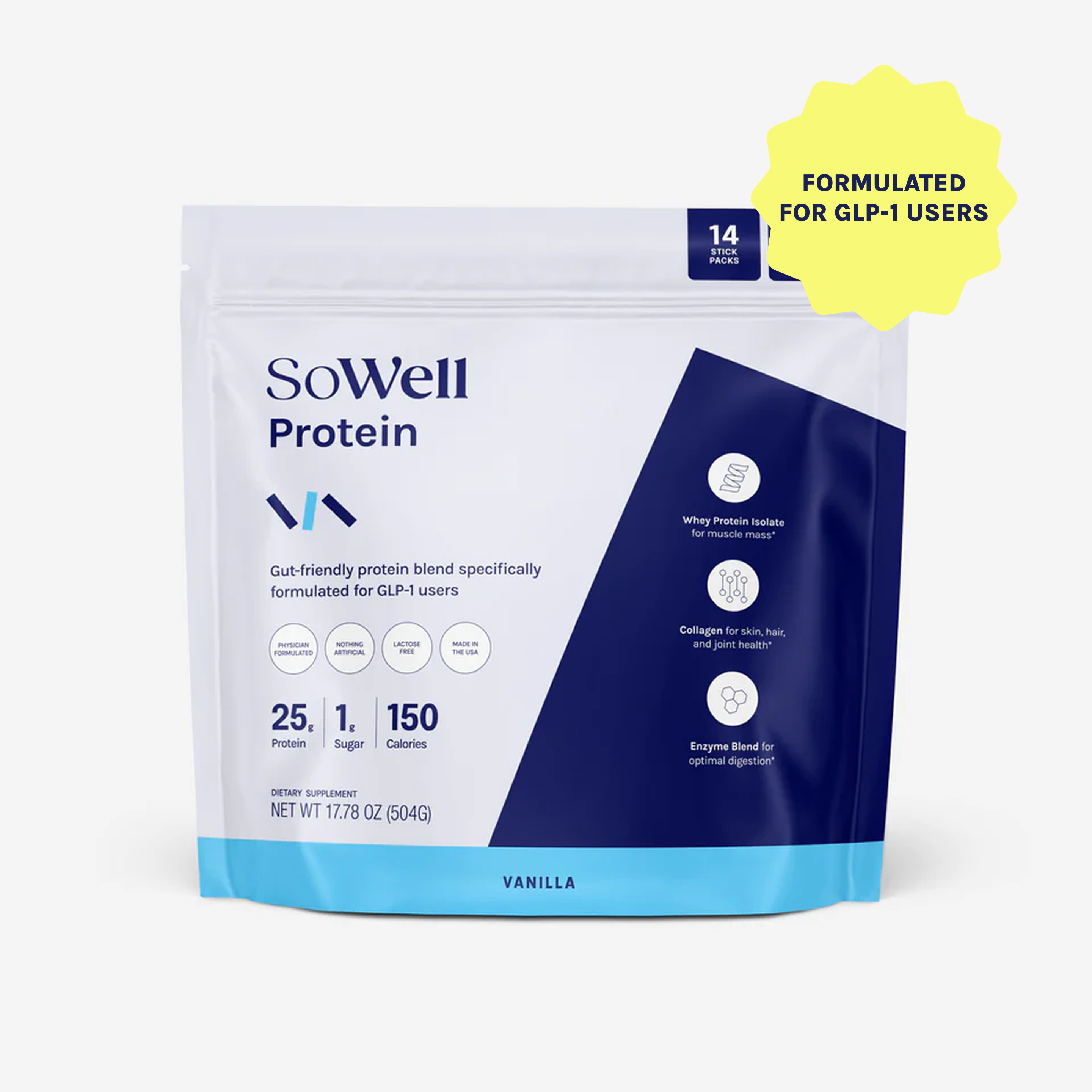
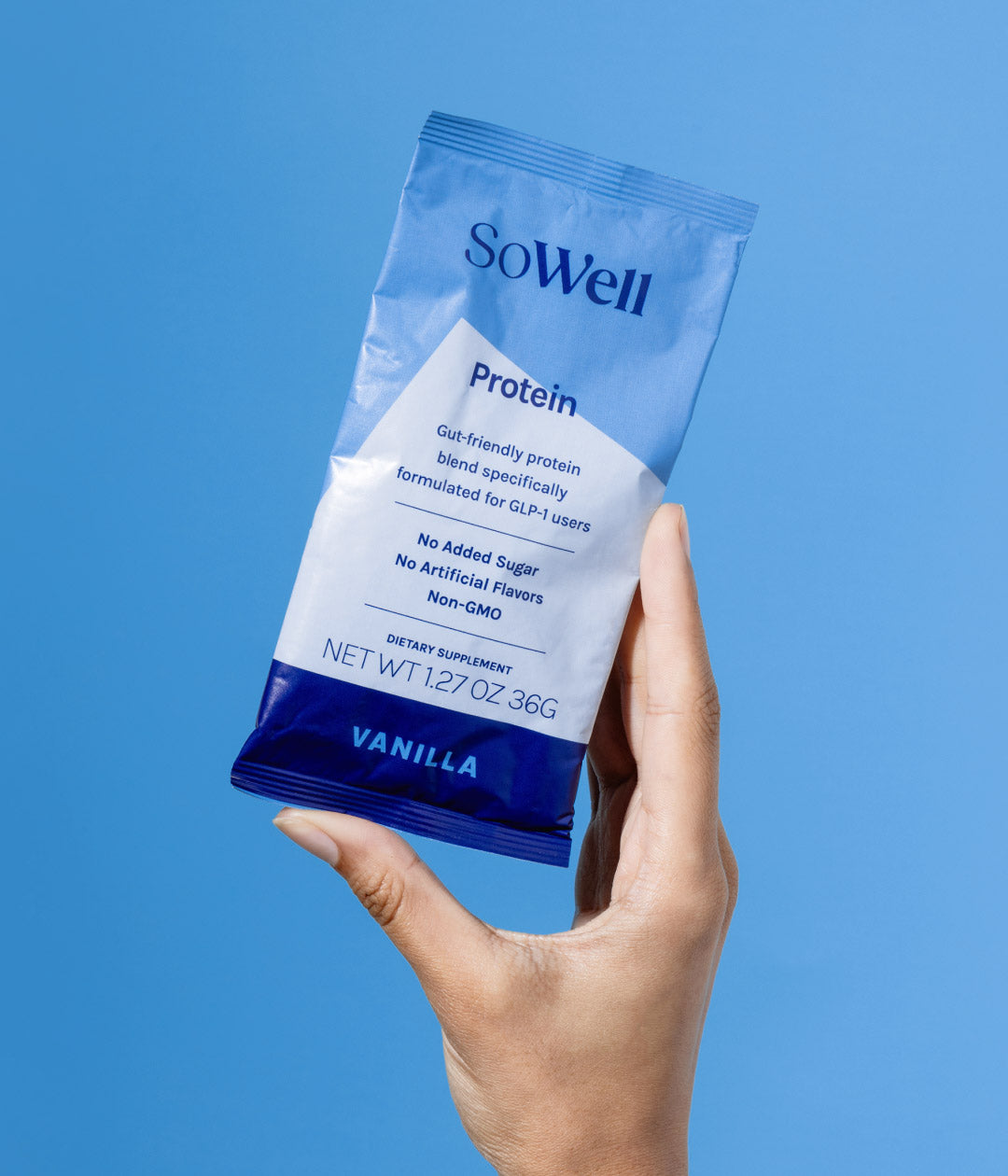
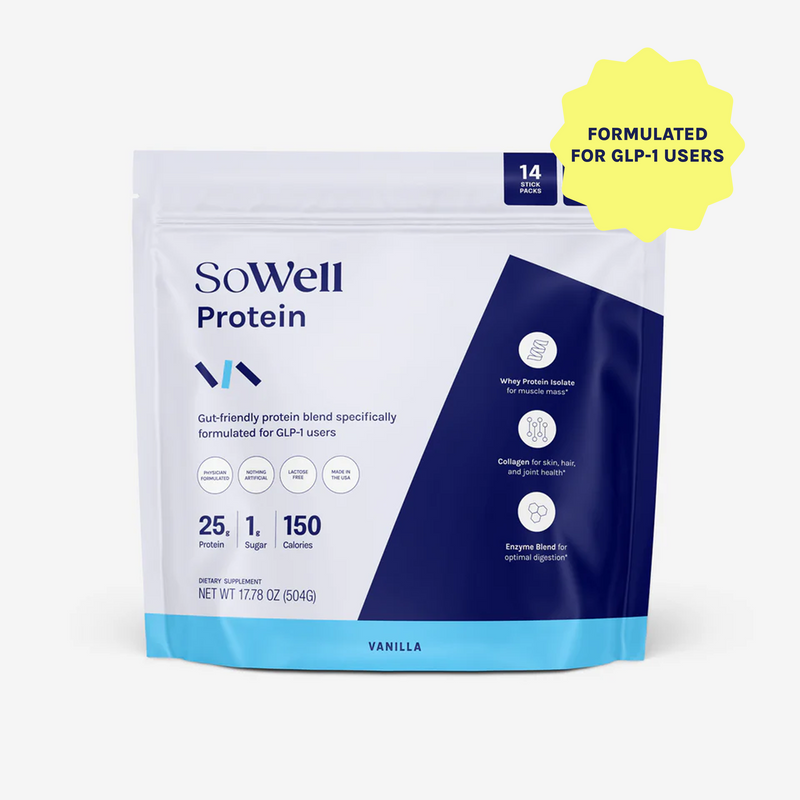
<p><a href="https://sowell.com/products/sowell-protein">SoWell Protein</a> was designed specifically for this problem. 25 grams of clean whey isolate per stick pack, low-carb, and — this is the part that matters — formulated with digestive enzymes (protease, lactase, bromelain) that help break the protein down in a gut that isn't moving at normal speed. One stick closes roughly a third of your daily gap. Two sticks plus one real meal gets most people to target without forcing food they don't want.</p>
<p>The stick-pack format matters too. When you're barely hungry, the last thing you'll do is measure scoops from a tub. Single-serve packets travel in a purse, a gym bag, a car console. You drink it when you remember, not when you feel like cooking.</p>
<h2>Protein Alone Doesn't Save Muscle. Neither Does Cardio.</h2>
<div class="tips-container">
<h3>The four-part muscle-preservation protocol</h3>
<div class="tips-across">
<div class="tip"><p><strong>Hit your protein number daily.</strong> Not "most days." Daily. Muscle protein synthesis runs on a 24-hour cycle, and a single low day can tip you into net breakdown — especially in a deficit.</p></div>
<div class="tip"><p><strong>Lift heavy things, two to three times a week.</strong> Resistance training is the actual signal that tells your body "keep this muscle, burn fat instead." Walking is great for health. It will not save your biceps.</p></div>
<div class="tip"><p><strong>Front-load protein early in the day.</strong> If appetite fades as the day goes on (most users report this), a 25–30g protein breakfast is non-negotiable. A <a href="https://sowell.com/products/sowell-protein">stick-pack shake</a> works when eggs feel like too much.</p></div>
<div class="tip"><p><strong>Track for two weeks, then stop.</strong> You only need to log food long enough to learn what 100 grams looks like on your plate. After that, you'll eyeball it. Nobody needs to live inside a food app forever.</p></div>
</div>
</div>
<h2>The Bottom Line</h2>
<div class="tips-container-bg">
<p>The muscle loss on GLP-1s is not a medication flaw. It's a nutrition gap the medication exposes — and it's almost entirely solvable with a protein target (1.0–1.2g per kg), a delivery method your suppressed appetite will actually cooperate with, and two to three resistance sessions a week. Your next step is to do the math for your body weight, find your daily number, and figure out how you're going to hit it when a chicken breast feels like climbing a wall.</p>
<p><strong>You didn't start this to end up smaller and weaker. Protect the muscle. The fat will follow.</strong></p>
</div>
<hr>
<h2>Your Questions About Protein on GLP-1s, Answered</h2>
<section class="gp-accordion-v2">
<details open=""><summary>How much protein do I actually need on a GLP-1 medication?<span aria-hidden="true" class="gp-icon"></span></summary><div class="gp-panel rte"><p>Research-backed targets during active weight loss are 1.0 to 1.2 grams of protein per kilogram of body weight per day — meaningfully higher than the general sedentary-adult recommendation of 0.8g/kg. For most GLP-1 users, that translates to 80 to 120 grams daily. Divide your weight in pounds by 2.2, then multiply by 1.0 (minimum) or 1.2 (target) to find your personal number.</p></div></details>
<details open=""><summary>Why does protein powder make me bloated on semaglutide or tirzepatide?<span aria-hidden="true" class="gp-icon"></span></summary><div class="gp-panel rte"><p>GLP-1 medications slow gastric emptying, so food and liquids sit in your stomach longer than before. Standard whey powders often contain lactose, gums, and artificial sweeteners that ferment in a slow-moving gut, causing bloating and cramping. Protein formulas designed for GLP-1 users typically use whey isolate (lower lactose) plus added digestive enzymes like protease, lactase, and bromelain to help break the protein down faster and reduce GI distress.</p></div></details>
<details open=""><summary>Can I just eat more chicken instead of using a protein shake?<span aria-hidden="true" class="gp-icon"></span></summary><div class="gp-panel rte"><p>If you can physically eat enough solid protein to hit 80–120 grams daily, yes. Most GLP-1 users cannot — suppressed appetite caps them at 40–60 grams from whole food alone. Liquid protein works because it takes up less stomach volume and empties faster, closing the gap between what your body needs and what your appetite will allow. It's not a preference. It's a mechanics issue.</p></div></details>
<details open=""><summary>Will I lose muscle on a GLP-1 no matter what I do?<span aria-hidden="true" class="gp-icon"></span></summary><div class="gp-panel rte"><p>Some lean-mass loss is expected with any significant weight loss, but the 25–40% muscle-loss figures seen in GLP-1 studies reflect average users — not ones actively resistance training and hitting protein targets. With adequate protein (1.0–1.2g/kg) and two to three strength sessions a week, most of the weight you lose can come from fat. The muscle loss is avoidable. It's just not automatic.</p></div></details>
</section>
<script type="application/ld+json">
{
"@context": "https://schema.org",
"@type": "FAQPage",
"mainEntity": [
{"@type": "Question", "name": "How much protein do I actually need on a GLP-1 medication?", "acceptedAnswer": {"@type": "Answer", "text": "Research-backed targets during active weight loss are 1.0 to 1.2 grams of protein per kilogram of body weight per day — meaningfully higher than the general sedentary-adult recommendation of 0.8g/kg. For most GLP-1 users, that translates to 80 to 120 grams daily. Divide your weight in pounds by 2.2, then multiply by 1.0 (minimum) or 1.2 (target) to find your personal number."}},
{"@type": "Question", "name": "Why does protein powder make me bloated on semaglutide or tirzepatide?", "acceptedAnswer": {"@type": "Answer", "text": "GLP-1 medications slow gastric emptying, so food and liquids sit in your stomach longer than before. Standard whey powders often contain lactose, gums, and artificial sweeteners that ferment in a slow-moving gut, causing bloating and cramping. Protein formulas designed for GLP-1 users typically use whey isolate (lower lactose) plus added digestive enzymes like protease, lactase, and bromelain to help break the protein down faster and reduce GI distress."}},
{"@type": "Question", "name": "Can I just eat more chicken instead of using a protein shake?", "acceptedAnswer": {"@type": "Answer", "text": "If you can physically eat enough solid protein to hit 80-120 grams daily, yes. Most GLP-1 users cannot — suppressed appetite caps them at 40-60 grams from whole food alone. Liquid protein works because it takes up less stomach volume and empties faster, closing the gap between what your body needs and what your appetite will allow. It's not a preference. It's a mechanics issue."}},
{"@type": "Question", "name": "Will I lose muscle on a GLP-1 no matter what I do?", "acceptedAnswer": {"@type": "Answer", "text": "Some lean-mass loss is expected with any significant weight loss, but the 25-40% muscle-loss figures seen in GLP-1 studies reflect average users — not ones actively resistance training and hitting protein targets. With adequate protein (1.0-1.2g/kg) and two to three strength sessions a week, most of the weight you lose can come from fat. The muscle loss is avoidable. It's just not automatic."}}
]
}
</script>
Losing Muscle on a GLP-1? The Protein Target Doctors Recommend (and How to Hit It)

In This Article
SoWell Protein
• Choose from 14 or 28 grab-and-go protein packets in a resealable, travel-friendly bag• Natural vanilla flavor mixes into anything• Easy-to-mix powder leaves no clumps•...
<p>You started a GLP-1 to lose fat. Nobody warned you that without a plan, up to 40% of what you lose can be muscle.</p>
<p>Here's the uncomfortable math: your appetite dropped 70%, but your protein requirement went <em>up</em>. Most people on semaglutide or tirzepatide are eating half the protein their body needs to protect lean mass — and they don't find out until the scale stops moving and the mirror starts looking softer instead of tighter.</p>
<p>This is fixable. But not with willpower.</p>
<h2>The Protein Target Your Doctor Probably Didn't Mention</h2>
<p>During active weight loss, research consistently points to <strong>1.0 to 1.2 grams of protein per kilogram of body weight</strong> — not the outdated 0.8g/kg figure printed on the side of a cereal box. That older number was built for sedentary adults in energy balance. You are neither. You're in a calorie deficit, on a medication that suppresses hunger, with hormonal signals telling your body it's safe to break down muscle for fuel.</p>
<p>For a 180-pound person, that's roughly 82 to 98 grams of protein every single day. For a 220-pound person, closer to 100 to 120 grams. Some clinicians working specifically with GLP-1 patients push the upper end even higher — 1.4 to 1.6g/kg — on the logic that if appetite suppression is going to cap your total food intake anyway, protein should take priority over everything else on the plate.</p>
<h6><strong>Quick protein math by body weight</strong></h6>
<ul>
<li><strong>130 lbs (59 kg):</strong> 59–71g daily minimum</li>
<li><strong>160 lbs (73 kg):</strong> 73–87g daily minimum</li>
<li><strong>180 lbs (82 kg):</strong> 82–98g daily minimum</li>
<li><strong>200 lbs (91 kg):</strong> 91–109g daily minimum</li>
<li><strong>220 lbs (100 kg):</strong> 100–120g daily minimum</li>
<li><strong>250 lbs (113 kg):</strong> 113–136g daily minimum</li>
</ul>
<p>The formula is simple: <strong>your weight in pounds ÷ 2.2 × 1.0 (minimum) or × 1.2 (target)</strong>. Write your number down. You're going to need it.</p>
<hr>
<h2>Why the Gap Exists (and Why Willpower Won't Close It)</h2>
<p>Here's what's actually happening in your body. GLP-1 medications slow gastric emptying — food sits in your stomach longer, which is how they create that "full after three bites" sensation. That mechanism is the whole point. It's also why most users cap out at 40 to 60 grams of protein a day without realizing it. A chicken breast that used to feel like lunch now feels like a challenge. Steak becomes a negotiation.</p>
<p>Meanwhile, a calorie deficit plus muscle disuse plus inadequate protein is the exact three-ingredient recipe for sarcopenic weight loss — fat-loss that drags muscle down with it. The studies on semaglutide and tirzepatide show lean mass can account for 25% to 40% of total weight lost when protein and resistance training aren't prioritized. That's not a rounding error. That's your metabolism dimming.</p>
<p>Muscle is metabolically expensive tissue. Lose it, and your resting energy expenditure drops. Drop that, and the rebound weight after you taper off the medication comes back as fat — on a lower metabolic floor than you started with. This is how people "succeed" on a GLP-1 for a year and then regain everything plus interest eighteen months later.</p>
<p>The gap between what you need (80–120g) and what you're eating (40–60g) is not a motivation problem. It's a mechanical one. Solid food takes up stomach volume you no longer have.</p>
<div class="twocolumn-container">
<div class="columnone">
<h2><strong><s>Just eat more chicken.</s> Stop treating this like a 2015 diet.</strong></h2>
<p>The advice that worked when your appetite was normal — "prioritize lean protein at every meal" — assumes you can physically eat three meals. On a GLP-1, you often can't. You need protein density, not volume. That means engineered sources (powders, bars, shakes) carrying their weight, not a plate of grilled chicken you'll leave half-finished.</p>
</div>
<div class="columntwo">
<h6>What a 100g protein day actually looks like</h6>
<ul>
<li>Morning shake: 25–30g</li>
<li>Greek yogurt + egg: 20g</li>
<li>Small lunch portion (4oz chicken): 28g</li>
<li>Evening shake or cottage cheese: 20–25g</li>
<li><strong>Total: ~95–103g</strong></li>
</ul>
</div>
</div>
<hr>
<h2>The Mechanical Solution: Liquid Protein That Doesn't Wreck Your Gut</h2>
<p>Powder is easier than meat when appetite is gone. That's not a marketing line — it's physics. A scoop of protein takes up a fraction of the stomach volume of an equivalent chicken breast, and it empties faster because it's already liquefied.</p>
<p>But most whey shakes hit a GLP-1-slowed gut like a brick. Bloating, cramping, that miserable heavy-stomach feeling for four hours after — this is why so many people try a standard protein powder on semaglutide, feel terrible, and quit. The lactose, the gums, the artificial sweeteners, the sheer load of undigested protein sitting in a stomach that's barely moving. Your digestion was already slow. You just added a cement mixer to it.</p>
<p><a href="https://sowell.com/products/sowell-protein">SoWell Protein</a> was designed specifically for this problem. 25 grams of clean whey isolate per stick pack, low-carb, and — this is the part that matters — formulated with digestive enzymes (protease, lactase, bromelain) that help break the protein down in a gut that isn't moving at normal speed. One stick closes roughly a third of your daily gap. Two sticks plus one real meal gets most people to target without forcing food they don't want.</p>
<p>The stick-pack format matters too. When you're barely hungry, the last thing you'll do is measure scoops from a tub. Single-serve packets travel in a purse, a gym bag, a car console. You drink it when you remember, not when you feel like cooking.</p>
<h2>Protein Alone Doesn't Save Muscle. Neither Does Cardio.</h2>
<div class="tips-container">
<h3>The four-part muscle-preservation protocol</h3>
<div class="tips-across">
<div class="tip"><p><strong>Hit your protein number daily.</strong> Not "most days." Daily. Muscle protein synthesis runs on a 24-hour cycle, and a single low day can tip you into net breakdown — especially in a deficit.</p></div>
<div class="tip"><p><strong>Lift heavy things, two to three times a week.</strong> Resistance training is the actual signal that tells your body "keep this muscle, burn fat instead." Walking is great for health. It will not save your biceps.</p></div>
<div class="tip"><p><strong>Front-load protein early in the day.</strong> If appetite fades as the day goes on (most users report this), a 25–30g protein breakfast is non-negotiable. A <a href="https://sowell.com/products/sowell-protein">stick-pack shake</a> works when eggs feel like too much.</p></div>
<div class="tip"><p><strong>Track for two weeks, then stop.</strong> You only need to log food long enough to learn what 100 grams looks like on your plate. After that, you'll eyeball it. Nobody needs to live inside a food app forever.</p></div>
</div>
</div>
<h2>The Bottom Line</h2>
<div class="tips-container-bg">
<p>The muscle loss on GLP-1s is not a medication flaw. It's a nutrition gap the medication exposes — and it's almost entirely solvable with a protein target (1.0–1.2g per kg), a delivery method your suppressed appetite will actually cooperate with, and two to three resistance sessions a week. Your next step is to do the math for your body weight, find your daily number, and figure out how you're going to hit it when a chicken breast feels like climbing a wall.</p>
<p><strong>You didn't start this to end up smaller and weaker. Protect the muscle. The fat will follow.</strong></p>
</div>
<hr>
<h2>Your Questions About Protein on GLP-1s, Answered</h2>
<section class="gp-accordion-v2">
<details open=""><summary>How much protein do I actually need on a GLP-1 medication?<span aria-hidden="true" class="gp-icon"></span></summary><div class="gp-panel rte"><p>Research-backed targets during active weight loss are 1.0 to 1.2 grams of protein per kilogram of body weight per day — meaningfully higher than the general sedentary-adult recommendation of 0.8g/kg. For most GLP-1 users, that translates to 80 to 120 grams daily. Divide your weight in pounds by 2.2, then multiply by 1.0 (minimum) or 1.2 (target) to find your personal number.</p></div></details>
<details open=""><summary>Why does protein powder make me bloated on semaglutide or tirzepatide?<span aria-hidden="true" class="gp-icon"></span></summary><div class="gp-panel rte"><p>GLP-1 medications slow gastric emptying, so food and liquids sit in your stomach longer than before. Standard whey powders often contain lactose, gums, and artificial sweeteners that ferment in a slow-moving gut, causing bloating and cramping. Protein formulas designed for GLP-1 users typically use whey isolate (lower lactose) plus added digestive enzymes like protease, lactase, and bromelain to help break the protein down faster and reduce GI distress.</p></div></details>
<details open=""><summary>Can I just eat more chicken instead of using a protein shake?<span aria-hidden="true" class="gp-icon"></span></summary><div class="gp-panel rte"><p>If you can physically eat enough solid protein to hit 80–120 grams daily, yes. Most GLP-1 users cannot — suppressed appetite caps them at 40–60 grams from whole food alone. Liquid protein works because it takes up less stomach volume and empties faster, closing the gap between what your body needs and what your appetite will allow. It's not a preference. It's a mechanics issue.</p></div></details>
<details open=""><summary>Will I lose muscle on a GLP-1 no matter what I do?<span aria-hidden="true" class="gp-icon"></span></summary><div class="gp-panel rte"><p>Some lean-mass loss is expected with any significant weight loss, but the 25–40% muscle-loss figures seen in GLP-1 studies reflect average users — not ones actively resistance training and hitting protein targets. With adequate protein (1.0–1.2g/kg) and two to three strength sessions a week, most of the weight you lose can come from fat. The muscle loss is avoidable. It's just not automatic.</p></div></details>
</section>
<script type="application/ld+json">
{
"@context": "https://schema.org",
"@type": "FAQPage",
"mainEntity": [
{"@type": "Question", "name": "How much protein do I actually need on a GLP-1 medication?", "acceptedAnswer": {"@type": "Answer", "text": "Research-backed targets during active weight loss are 1.0 to 1.2 grams of protein per kilogram of body weight per day — meaningfully higher than the general sedentary-adult recommendation of 0.8g/kg. For most GLP-1 users, that translates to 80 to 120 grams daily. Divide your weight in pounds by 2.2, then multiply by 1.0 (minimum) or 1.2 (target) to find your personal number."}},
{"@type": "Question", "name": "Why does protein powder make me bloated on semaglutide or tirzepatide?", "acceptedAnswer": {"@type": "Answer", "text": "GLP-1 medications slow gastric emptying, so food and liquids sit in your stomach longer than before. Standard whey powders often contain lactose, gums, and artificial sweeteners that ferment in a slow-moving gut, causing bloating and cramping. Protein formulas designed for GLP-1 users typically use whey isolate (lower lactose) plus added digestive enzymes like protease, lactase, and bromelain to help break the protein down faster and reduce GI distress."}},
{"@type": "Question", "name": "Can I just eat more chicken instead of using a protein shake?", "acceptedAnswer": {"@type": "Answer", "text": "If you can physically eat enough solid protein to hit 80-120 grams daily, yes. Most GLP-1 users cannot — suppressed appetite caps them at 40-60 grams from whole food alone. Liquid protein works because it takes up less stomach volume and empties faster, closing the gap between what your body needs and what your appetite will allow. It's not a preference. It's a mechanics issue."}},
{"@type": "Question", "name": "Will I lose muscle on a GLP-1 no matter what I do?", "acceptedAnswer": {"@type": "Answer", "text": "Some lean-mass loss is expected with any significant weight loss, but the 25-40% muscle-loss figures seen in GLP-1 studies reflect average users — not ones actively resistance training and hitting protein targets. With adequate protein (1.0-1.2g/kg) and two to three strength sessions a week, most of the weight you lose can come from fat. The muscle loss is avoidable. It's just not automatic."}}
]
}
</script>
<p>You started a GLP-1 to lose fat. Nobody warned you that without a plan, up to 40% of what you lose can be muscle.</p>
<p>Here's the uncomfortable math: your appetite dropped 70%, but your protein requirement went <em>up</em>. Most people on semaglutide or tirzepatide are eating half the protein their body needs to protect lean mass — and they don't find out until the scale stops moving and the mirror starts looking softer instead of tighter.</p>
<p>This is fixable. But not with willpower.</p>
<h2>The Protein Target Your Doctor Probably Didn't Mention</h2>
<p>During active weight loss, research consistently points to <strong>1.0 to 1.2 grams of protein per kilogram of body weight</strong> — not the outdated 0.8g/kg figure printed on the side of a cereal box. That older number was built for sedentary adults in energy balance. You are neither. You're in a calorie deficit, on a medication that suppresses hunger, with hormonal signals telling your body it's safe to break down muscle for fuel.</p>
<p>For a 180-pound person, that's roughly 82 to 98 grams of protein every single day. For a 220-pound person, closer to 100 to 120 grams. Some clinicians working specifically with GLP-1 patients push the upper end even higher — 1.4 to 1.6g/kg — on the logic that if appetite suppression is going to cap your total food intake anyway, protein should take priority over everything else on the plate.</p>
<h6><strong>Quick protein math by body weight</strong></h6>
<ul>
<li><strong>130 lbs (59 kg):</strong> 59–71g daily minimum</li>
<li><strong>160 lbs (73 kg):</strong> 73–87g daily minimum</li>
<li><strong>180 lbs (82 kg):</strong> 82–98g daily minimum</li>
<li><strong>200 lbs (91 kg):</strong> 91–109g daily minimum</li>
<li><strong>220 lbs (100 kg):</strong> 100–120g daily minimum</li>
<li><strong>250 lbs (113 kg):</strong> 113–136g daily minimum</li>
</ul>
<p>The formula is simple: <strong>your weight in pounds ÷ 2.2 × 1.0 (minimum) or × 1.2 (target)</strong>. Write your number down. You're going to need it.</p>
<hr>
<h2>Why the Gap Exists (and Why Willpower Won't Close It)</h2>
<p>Here's what's actually happening in your body. GLP-1 medications slow gastric emptying — food sits in your stomach longer, which is how they create that "full after three bites" sensation. That mechanism is the whole point. It's also why most users cap out at 40 to 60 grams of protein a day without realizing it. A chicken breast that used to feel like lunch now feels like a challenge. Steak becomes a negotiation.</p>
<p>Meanwhile, a calorie deficit plus muscle disuse plus inadequate protein is the exact three-ingredient recipe for sarcopenic weight loss — fat-loss that drags muscle down with it. The studies on semaglutide and tirzepatide show lean mass can account for 25% to 40% of total weight lost when protein and resistance training aren't prioritized. That's not a rounding error. That's your metabolism dimming.</p>
<p>Muscle is metabolically expensive tissue. Lose it, and your resting energy expenditure drops. Drop that, and the rebound weight after you taper off the medication comes back as fat — on a lower metabolic floor than you started with. This is how people "succeed" on a GLP-1 for a year and then regain everything plus interest eighteen months later.</p>
<p>The gap between what you need (80–120g) and what you're eating (40–60g) is not a motivation problem. It's a mechanical one. Solid food takes up stomach volume you no longer have.</p>
<div class="twocolumn-container">
<div class="columnone">
<h2><strong><s>Just eat more chicken.</s> Stop treating this like a 2015 diet.</strong></h2>
<p>The advice that worked when your appetite was normal — "prioritize lean protein at every meal" — assumes you can physically eat three meals. On a GLP-1, you often can't. You need protein density, not volume. That means engineered sources (powders, bars, shakes) carrying their weight, not a plate of grilled chicken you'll leave half-finished.</p>
</div>
<div class="columntwo">
<h6>What a 100g protein day actually looks like</h6>
<ul>
<li>Morning shake: 25–30g</li>
<li>Greek yogurt + egg: 20g</li>
<li>Small lunch portion (4oz chicken): 28g</li>
<li>Evening shake or cottage cheese: 20–25g</li>
<li><strong>Total: ~95–103g</strong></li>
</ul>
</div>
</div>
<hr>
<h2>The Mechanical Solution: Liquid Protein That Doesn't Wreck Your Gut</h2>
<p>Powder is easier than meat when appetite is gone. That's not a marketing line — it's physics. A scoop of protein takes up a fraction of the stomach volume of an equivalent chicken breast, and it empties faster because it's already liquefied.</p>
<p>But most whey shakes hit a GLP-1-slowed gut like a brick. Bloating, cramping, that miserable heavy-stomach feeling for four hours after — this is why so many people try a standard protein powder on semaglutide, feel terrible, and quit. The lactose, the gums, the artificial sweeteners, the sheer load of undigested protein sitting in a stomach that's barely moving. Your digestion was already slow. You just added a cement mixer to it.</p>
<p><a href="https://sowell.com/products/sowell-protein">SoWell Protein</a> was designed specifically for this problem. 25 grams of clean whey isolate per stick pack, low-carb, and — this is the part that matters — formulated with digestive enzymes (protease, lactase, bromelain) that help break the protein down in a gut that isn't moving at normal speed. One stick closes roughly a third of your daily gap. Two sticks plus one real meal gets most people to target without forcing food they don't want.</p>
<p>The stick-pack format matters too. When you're barely hungry, the last thing you'll do is measure scoops from a tub. Single-serve packets travel in a purse, a gym bag, a car console. You drink it when you remember, not when you feel like cooking.</p>
<h2>Protein Alone Doesn't Save Muscle. Neither Does Cardio.</h2>
<div class="tips-container">
<h3>The four-part muscle-preservation protocol</h3>
<div class="tips-across">
<div class="tip"><p><strong>Hit your protein number daily.</strong> Not "most days." Daily. Muscle protein synthesis runs on a 24-hour cycle, and a single low day can tip you into net breakdown — especially in a deficit.</p></div>
<div class="tip"><p><strong>Lift heavy things, two to three times a week.</strong> Resistance training is the actual signal that tells your body "keep this muscle, burn fat instead." Walking is great for health. It will not save your biceps.</p></div>
<div class="tip"><p><strong>Front-load protein early in the day.</strong> If appetite fades as the day goes on (most users report this), a 25–30g protein breakfast is non-negotiable. A <a href="https://sowell.com/products/sowell-protein">stick-pack shake</a> works when eggs feel like too much.</p></div>
<div class="tip"><p><strong>Track for two weeks, then stop.</strong> You only need to log food long enough to learn what 100 grams looks like on your plate. After that, you'll eyeball it. Nobody needs to live inside a food app forever.</p></div>
</div>
</div>
<h2>The Bottom Line</h2>
<div class="tips-container-bg">
<p>The muscle loss on GLP-1s is not a medication flaw. It's a nutrition gap the medication exposes — and it's almost entirely solvable with a protein target (1.0–1.2g per kg), a delivery method your suppressed appetite will actually cooperate with, and two to three resistance sessions a week. Your next step is to do the math for your body weight, find your daily number, and figure out how you're going to hit it when a chicken breast feels like climbing a wall.</p>
<p><strong>You didn't start this to end up smaller and weaker. Protect the muscle. The fat will follow.</strong></p>
</div>
<hr>
<h2>Your Questions About Protein on GLP-1s, Answered</h2>
<section class="gp-accordion-v2">
<details open=""><summary>How much protein do I actually need on a GLP-1 medication?<span aria-hidden="true" class="gp-icon"></span></summary><div class="gp-panel rte"><p>Research-backed targets during active weight loss are 1.0 to 1.2 grams of protein per kilogram of body weight per day — meaningfully higher than the general sedentary-adult recommendation of 0.8g/kg. For most GLP-1 users, that translates to 80 to 120 grams daily. Divide your weight in pounds by 2.2, then multiply by 1.0 (minimum) or 1.2 (target) to find your personal number.</p></div></details>
<details open=""><summary>Why does protein powder make me bloated on semaglutide or tirzepatide?<span aria-hidden="true" class="gp-icon"></span></summary><div class="gp-panel rte"><p>GLP-1 medications slow gastric emptying, so food and liquids sit in your stomach longer than before. Standard whey powders often contain lactose, gums, and artificial sweeteners that ferment in a slow-moving gut, causing bloating and cramping. Protein formulas designed for GLP-1 users typically use whey isolate (lower lactose) plus added digestive enzymes like protease, lactase, and bromelain to help break the protein down faster and reduce GI distress.</p></div></details>
<details open=""><summary>Can I just eat more chicken instead of using a protein shake?<span aria-hidden="true" class="gp-icon"></span></summary><div class="gp-panel rte"><p>If you can physically eat enough solid protein to hit 80–120 grams daily, yes. Most GLP-1 users cannot — suppressed appetite caps them at 40–60 grams from whole food alone. Liquid protein works because it takes up less stomach volume and empties faster, closing the gap between what your body needs and what your appetite will allow. It's not a preference. It's a mechanics issue.</p></div></details>
<details open=""><summary>Will I lose muscle on a GLP-1 no matter what I do?<span aria-hidden="true" class="gp-icon"></span></summary><div class="gp-panel rte"><p>Some lean-mass loss is expected with any significant weight loss, but the 25–40% muscle-loss figures seen in GLP-1 studies reflect average users — not ones actively resistance training and hitting protein targets. With adequate protein (1.0–1.2g/kg) and two to three strength sessions a week, most of the weight you lose can come from fat. The muscle loss is avoidable. It's just not automatic.</p></div></details>
</section>
<script type="application/ld+json">
{
"@context": "https://schema.org",
"@type": "FAQPage",
"mainEntity": [
{"@type": "Question", "name": "How much protein do I actually need on a GLP-1 medication?", "acceptedAnswer": {"@type": "Answer", "text": "Research-backed targets during active weight loss are 1.0 to 1.2 grams of protein per kilogram of body weight per day — meaningfully higher than the general sedentary-adult recommendation of 0.8g/kg. For most GLP-1 users, that translates to 80 to 120 grams daily. Divide your weight in pounds by 2.2, then multiply by 1.0 (minimum) or 1.2 (target) to find your personal number."}},
{"@type": "Question", "name": "Why does protein powder make me bloated on semaglutide or tirzepatide?", "acceptedAnswer": {"@type": "Answer", "text": "GLP-1 medications slow gastric emptying, so food and liquids sit in your stomach longer than before. Standard whey powders often contain lactose, gums, and artificial sweeteners that ferment in a slow-moving gut, causing bloating and cramping. Protein formulas designed for GLP-1 users typically use whey isolate (lower lactose) plus added digestive enzymes like protease, lactase, and bromelain to help break the protein down faster and reduce GI distress."}},
{"@type": "Question", "name": "Can I just eat more chicken instead of using a protein shake?", "acceptedAnswer": {"@type": "Answer", "text": "If you can physically eat enough solid protein to hit 80-120 grams daily, yes. Most GLP-1 users cannot — suppressed appetite caps them at 40-60 grams from whole food alone. Liquid protein works because it takes up less stomach volume and empties faster, closing the gap between what your body needs and what your appetite will allow. It's not a preference. It's a mechanics issue."}},
{"@type": "Question", "name": "Will I lose muscle on a GLP-1 no matter what I do?", "acceptedAnswer": {"@type": "Answer", "text": "Some lean-mass loss is expected with any significant weight loss, but the 25-40% muscle-loss figures seen in GLP-1 studies reflect average users — not ones actively resistance training and hitting protein targets. With adequate protein (1.0-1.2g/kg) and two to three strength sessions a week, most of the weight you lose can come from fat. The muscle loss is avoidable. It's just not automatic."}}
]
}
</script>
<p>You started a GLP-1 to lose fat. Nobody warned you that without a plan, up to 40% of what you lose can be muscle.</p>
<p>Here's the uncomfortable math: your appetite dropped 70%, but your protein requirement went <em>up</em>. Most people on semaglutide or tirzepatide are eating half the protein their body needs to protect lean mass — and they don't find out until the scale stops moving and the mirror starts looking softer instead of tighter.</p>
<p>This is fixable. But not with willpower.</p>
<h2>The Protein Target Your Doctor Probably Didn't Mention</h2>
<p>During active weight loss, research consistently points to <strong>1.0 to 1.2 grams of protein per kilogram of body weight</strong> — not the outdated 0.8g/kg figure printed on the side of a cereal box. That older number was built for sedentary adults in energy balance. You are neither. You're in a calorie deficit, on a medication that suppresses hunger, with hormonal signals telling your body it's safe to break down muscle for fuel.</p>
<p>For a 180-pound person, that's roughly 82 to 98 grams of protein every single day. For a 220-pound person, closer to 100 to 120 grams. Some clinicians working specifically with GLP-1 patients push the upper end even higher — 1.4 to 1.6g/kg — on the logic that if appetite suppression is going to cap your total food intake anyway, protein should take priority over everything else on the plate.</p>
<h6><strong>Quick protein math by body weight</strong></h6>
<ul>
<li><strong>130 lbs (59 kg):</strong> 59–71g daily minimum</li>
<li><strong>160 lbs (73 kg):</strong> 73–87g daily minimum</li>
<li><strong>180 lbs (82 kg):</strong> 82–98g daily minimum</li>
<li><strong>200 lbs (91 kg):</strong> 91–109g daily minimum</li>
<li><strong>220 lbs (100 kg):</strong> 100–120g daily minimum</li>
<li><strong>250 lbs (113 kg):</strong> 113–136g daily minimum</li>
</ul>
<p>The formula is simple: <strong>your weight in pounds ÷ 2.2 × 1.0 (minimum) or × 1.2 (target)</strong>. Write your number down. You're going to need it.</p>
<hr>
<h2>Why the Gap Exists (and Why Willpower Won't Close It)</h2>
<p>Here's what's actually happening in your body. GLP-1 medications slow gastric emptying — food sits in your stomach longer, which is how they create that "full after three bites" sensation. That mechanism is the whole point. It's also why most users cap out at 40 to 60 grams of protein a day without realizing it. A chicken breast that used to feel like lunch now feels like a challenge. Steak becomes a negotiation.</p>
<p>Meanwhile, a calorie deficit plus muscle disuse plus inadequate protein is the exact three-ingredient recipe for sarcopenic weight loss — fat-loss that drags muscle down with it. The studies on semaglutide and tirzepatide show lean mass can account for 25% to 40% of total weight lost when protein and resistance training aren't prioritized. That's not a rounding error. That's your metabolism dimming.</p>
<p>Muscle is metabolically expensive tissue. Lose it, and your resting energy expenditure drops. Drop that, and the rebound weight after you taper off the medication comes back as fat — on a lower metabolic floor than you started with. This is how people "succeed" on a GLP-1 for a year and then regain everything plus interest eighteen months later.</p>
<p>The gap between what you need (80–120g) and what you're eating (40–60g) is not a motivation problem. It's a mechanical one. Solid food takes up stomach volume you no longer have.</p>
<div class="twocolumn-container">
<div class="columnone">
<h2><strong><s>Just eat more chicken.</s> Stop treating this like a 2015 diet.</strong></h2>
<p>The advice that worked when your appetite was normal — "prioritize lean protein at every meal" — assumes you can physically eat three meals. On a GLP-1, you often can't. You need protein density, not volume. That means engineered sources (powders, bars, shakes) carrying their weight, not a plate of grilled chicken you'll leave half-finished.</p>
</div>
<div class="columntwo">
<h6>What a 100g protein day actually looks like</h6>
<ul>
<li>Morning shake: 25–30g</li>
<li>Greek yogurt + egg: 20g</li>
<li>Small lunch portion (4oz chicken): 28g</li>
<li>Evening shake or cottage cheese: 20–25g</li>
<li><strong>Total: ~95–103g</strong></li>
</ul>
</div>
</div>
<hr>
<h2>The Mechanical Solution: Liquid Protein That Doesn't Wreck Your Gut</h2>
<p>Powder is easier than meat when appetite is gone. That's not a marketing line — it's physics. A scoop of protein takes up a fraction of the stomach volume of an equivalent chicken breast, and it empties faster because it's already liquefied.</p>
<p>But most whey shakes hit a GLP-1-slowed gut like a brick. Bloating, cramping, that miserable heavy-stomach feeling for four hours after — this is why so many people try a standard protein powder on semaglutide, feel terrible, and quit. The lactose, the gums, the artificial sweeteners, the sheer load of undigested protein sitting in a stomach that's barely moving. Your digestion was already slow. You just added a cement mixer to it.</p>
<p><a href="https://sowell.com/products/sowell-protein">SoWell Protein</a> was designed specifically for this problem. 25 grams of clean whey isolate per stick pack, low-carb, and — this is the part that matters — formulated with digestive enzymes (protease, lactase, bromelain) that help break the protein down in a gut that isn't moving at normal speed. One stick closes roughly a third of your daily gap. Two sticks plus one real meal gets most people to target without forcing food they don't want.</p>
<p>The stick-pack format matters too. When you're barely hungry, the last thing you'll do is measure scoops from a tub. Single-serve packets travel in a purse, a gym bag, a car console. You drink it when you remember, not when you feel like cooking.</p>
<h2>Protein Alone Doesn't Save Muscle. Neither Does Cardio.</h2>
<div class="tips-container">
<h3>The four-part muscle-preservation protocol</h3>
<div class="tips-across">
<div class="tip"><p><strong>Hit your protein number daily.</strong> Not "most days." Daily. Muscle protein synthesis runs on a 24-hour cycle, and a single low day can tip you into net breakdown — especially in a deficit.</p></div>
<div class="tip"><p><strong>Lift heavy things, two to three times a week.</strong> Resistance training is the actual signal that tells your body "keep this muscle, burn fat instead." Walking is great for health. It will not save your biceps.</p></div>
<div class="tip"><p><strong>Front-load protein early in the day.</strong> If appetite fades as the day goes on (most users report this), a 25–30g protein breakfast is non-negotiable. A <a href="https://sowell.com/products/sowell-protein">stick-pack shake</a> works when eggs feel like too much.</p></div>
<div class="tip"><p><strong>Track for two weeks, then stop.</strong> You only need to log food long enough to learn what 100 grams looks like on your plate. After that, you'll eyeball it. Nobody needs to live inside a food app forever.</p></div>
</div>
</div>
<h2>The Bottom Line</h2>
<div class="tips-container-bg">
<p>The muscle loss on GLP-1s is not a medication flaw. It's a nutrition gap the medication exposes — and it's almost entirely solvable with a protein target (1.0–1.2g per kg), a delivery method your suppressed appetite will actually cooperate with, and two to three resistance sessions a week. Your next step is to do the math for your body weight, find your daily number, and figure out how you're going to hit it when a chicken breast feels like climbing a wall.</p>
<p><strong>You didn't start this to end up smaller and weaker. Protect the muscle. The fat will follow.</strong></p>
</div>
<hr>
<h2>Your Questions About Protein on GLP-1s, Answered</h2>
<section class="gp-accordion-v2">
<details open=""><summary>How much protein do I actually need on a GLP-1 medication?<span aria-hidden="true" class="gp-icon"></span></summary><div class="gp-panel rte"><p>Research-backed targets during active weight loss are 1.0 to 1.2 grams of protein per kilogram of body weight per day — meaningfully higher than the general sedentary-adult recommendation of 0.8g/kg. For most GLP-1 users, that translates to 80 to 120 grams daily. Divide your weight in pounds by 2.2, then multiply by 1.0 (minimum) or 1.2 (target) to find your personal number.</p></div></details>
<details open=""><summary>Why does protein powder make me bloated on semaglutide or tirzepatide?<span aria-hidden="true" class="gp-icon"></span></summary><div class="gp-panel rte"><p>GLP-1 medications slow gastric emptying, so food and liquids sit in your stomach longer than before. Standard whey powders often contain lactose, gums, and artificial sweeteners that ferment in a slow-moving gut, causing bloating and cramping. Protein formulas designed for GLP-1 users typically use whey isolate (lower lactose) plus added digestive enzymes like protease, lactase, and bromelain to help break the protein down faster and reduce GI distress.</p></div></details>
<details open=""><summary>Can I just eat more chicken instead of using a protein shake?<span aria-hidden="true" class="gp-icon"></span></summary><div class="gp-panel rte"><p>If you can physically eat enough solid protein to hit 80–120 grams daily, yes. Most GLP-1 users cannot — suppressed appetite caps them at 40–60 grams from whole food alone. Liquid protein works because it takes up less stomach volume and empties faster, closing the gap between what your body needs and what your appetite will allow. It's not a preference. It's a mechanics issue.</p></div></details>
<details open=""><summary>Will I lose muscle on a GLP-1 no matter what I do?<span aria-hidden="true" class="gp-icon"></span></summary><div class="gp-panel rte"><p>Some lean-mass loss is expected with any significant weight loss, but the 25–40% muscle-loss figures seen in GLP-1 studies reflect average users — not ones actively resistance training and hitting protein targets. With adequate protein (1.0–1.2g/kg) and two to three strength sessions a week, most of the weight you lose can come from fat. The muscle loss is avoidable. It's just not automatic.</p></div></details>
</section>
<script type="application/ld+json">
{
"@context": "https://schema.org",
"@type": "FAQPage",
"mainEntity": [
{"@type": "Question", "name": "How much protein do I actually need on a GLP-1 medication?", "acceptedAnswer": {"@type": "Answer", "text": "Research-backed targets during active weight loss are 1.0 to 1.2 grams of protein per kilogram of body weight per day — meaningfully higher than the general sedentary-adult recommendation of 0.8g/kg. For most GLP-1 users, that translates to 80 to 120 grams daily. Divide your weight in pounds by 2.2, then multiply by 1.0 (minimum) or 1.2 (target) to find your personal number."}},
{"@type": "Question", "name": "Why does protein powder make me bloated on semaglutide or tirzepatide?", "acceptedAnswer": {"@type": "Answer", "text": "GLP-1 medications slow gastric emptying, so food and liquids sit in your stomach longer than before. Standard whey powders often contain lactose, gums, and artificial sweeteners that ferment in a slow-moving gut, causing bloating and cramping. Protein formulas designed for GLP-1 users typically use whey isolate (lower lactose) plus added digestive enzymes like protease, lactase, and bromelain to help break the protein down faster and reduce GI distress."}},
{"@type": "Question", "name": "Can I just eat more chicken instead of using a protein shake?", "acceptedAnswer": {"@type": "Answer", "text": "If you can physically eat enough solid protein to hit 80-120 grams daily, yes. Most GLP-1 users cannot — suppressed appetite caps them at 40-60 grams from whole food alone. Liquid protein works because it takes up less stomach volume and empties faster, closing the gap between what your body needs and what your appetite will allow. It's not a preference. It's a mechanics issue."}},
{"@type": "Question", "name": "Will I lose muscle on a GLP-1 no matter what I do?", "acceptedAnswer": {"@type": "Answer", "text": "Some lean-mass loss is expected with any significant weight loss, but the 25-40% muscle-loss figures seen in GLP-1 studies reflect average users — not ones actively resistance training and hitting protein targets. With adequate protein (1.0-1.2g/kg) and two to three strength sessions a week, most of the weight you lose can come from fat. The muscle loss is avoidable. It's just not automatic."}}
]
}
</script>

GLP-1 Support System Sample Pack
GLP-1 Support System Sample Pack
<p>You started a GLP-1 to lose fat. Nobody warned you that without a plan, up to 40% of what you lose can be muscle.</p>
<p>Here's the uncomfortable math: your appetite dropped 70%, but your protein requirement went <em>up</em>. Most people on semaglutide or tirzepatide are eating half the protein their body needs to protect lean mass — and they don't find out until the scale stops moving and the mirror starts looking softer instead of tighter.</p>
<p>This is fixable. But not with willpower.</p>
<h2>The Protein Target Your Doctor Probably Didn't Mention</h2>
<p>During active weight loss, research consistently points to <strong>1.0 to 1.2 grams of protein per kilogram of body weight</strong> — not the outdated 0.8g/kg figure printed on the side of a cereal box. That older number was built for sedentary adults in energy balance. You are neither. You're in a calorie deficit, on a medication that suppresses hunger, with hormonal signals telling your body it's safe to break down muscle for fuel.</p>
<p>For a 180-pound person, that's roughly 82 to 98 grams of protein every single day. For a 220-pound person, closer to 100 to 120 grams. Some clinicians working specifically with GLP-1 patients push the upper end even higher — 1.4 to 1.6g/kg — on the logic that if appetite suppression is going to cap your total food intake anyway, protein should take priority over everything else on the plate.</p>
<h6><strong>Quick protein math by body weight</strong></h6>
<ul>
<li><strong>130 lbs (59 kg):</strong> 59–71g daily minimum</li>
<li><strong>160 lbs (73 kg):</strong> 73–87g daily minimum</li>
<li><strong>180 lbs (82 kg):</strong> 82–98g daily minimum</li>
<li><strong>200 lbs (91 kg):</strong> 91–109g daily minimum</li>
<li><strong>220 lbs (100 kg):</strong> 100–120g daily minimum</li>
<li><strong>250 lbs (113 kg):</strong> 113–136g daily minimum</li>
</ul>
<p>The formula is simple: <strong>your weight in pounds ÷ 2.2 × 1.0 (minimum) or × 1.2 (target)</strong>. Write your number down. You're going to need it.</p>
<hr>
<h2>Why the Gap Exists (and Why Willpower Won't Close It)</h2>
<p>Here's what's actually happening in your body. GLP-1 medications slow gastric emptying — food sits in your stomach longer, which is how they create that "full after three bites" sensation. That mechanism is the whole point. It's also why most users cap out at 40 to 60 grams of protein a day without realizing it. A chicken breast that used to feel like lunch now feels like a challenge. Steak becomes a negotiation.</p>
<p>Meanwhile, a calorie deficit plus muscle disuse plus inadequate protein is the exact three-ingredient recipe for sarcopenic weight loss — fat-loss that drags muscle down with it. The studies on semaglutide and tirzepatide show lean mass can account for 25% to 40% of total weight lost when protein and resistance training aren't prioritized. That's not a rounding error. That's your metabolism dimming.</p>
<p>Muscle is metabolically expensive tissue. Lose it, and your resting energy expenditure drops. Drop that, and the rebound weight after you taper off the medication comes back as fat — on a lower metabolic floor than you started with. This is how people "succeed" on a GLP-1 for a year and then regain everything plus interest eighteen months later.</p>
<p>The gap between what you need (80–120g) and what you're eating (40–60g) is not a motivation problem. It's a mechanical one. Solid food takes up stomach volume you no longer have.</p>
<div class="twocolumn-container">
<div class="columnone">
<h2><strong><s>Just eat more chicken.</s> Stop treating this like a 2015 diet.</strong></h2>
<p>The advice that worked when your appetite was normal — "prioritize lean protein at every meal" — assumes you can physically eat three meals. On a GLP-1, you often can't. You need protein density, not volume. That means engineered sources (powders, bars, shakes) carrying their weight, not a plate of grilled chicken you'll leave half-finished.</p>
</div>
<div class="columntwo">
<h6>What a 100g protein day actually looks like</h6>
<ul>
<li>Morning shake: 25–30g</li>
<li>Greek yogurt + egg: 20g</li>
<li>Small lunch portion (4oz chicken): 28g</li>
<li>Evening shake or cottage cheese: 20–25g</li>
<li><strong>Total: ~95–103g</strong></li>
</ul>
</div>
</div>
<hr>
<h2>The Mechanical Solution: Liquid Protein That Doesn't Wreck Your Gut</h2>
<p>Powder is easier than meat when appetite is gone. That's not a marketing line — it's physics. A scoop of protein takes up a fraction of the stomach volume of an equivalent chicken breast, and it empties faster because it's already liquefied.</p>
<p>But most whey shakes hit a GLP-1-slowed gut like a brick. Bloating, cramping, that miserable heavy-stomach feeling for four hours after — this is why so many people try a standard protein powder on semaglutide, feel terrible, and quit. The lactose, the gums, the artificial sweeteners, the sheer load of undigested protein sitting in a stomach that's barely moving. Your digestion was already slow. You just added a cement mixer to it.</p>
<p><a href="https://sowell.com/products/sowell-protein">SoWell Protein</a> was designed specifically for this problem. 25 grams of clean whey isolate per stick pack, low-carb, and — this is the part that matters — formulated with digestive enzymes (protease, lactase, bromelain) that help break the protein down in a gut that isn't moving at normal speed. One stick closes roughly a third of your daily gap. Two sticks plus one real meal gets most people to target without forcing food they don't want.</p>
<p>The stick-pack format matters too. When you're barely hungry, the last thing you'll do is measure scoops from a tub. Single-serve packets travel in a purse, a gym bag, a car console. You drink it when you remember, not when you feel like cooking.</p>
<h2>Protein Alone Doesn't Save Muscle. Neither Does Cardio.</h2>
<div class="tips-container">
<h3>The four-part muscle-preservation protocol</h3>
<div class="tips-across">
<div class="tip"><p><strong>Hit your protein number daily.</strong> Not "most days." Daily. Muscle protein synthesis runs on a 24-hour cycle, and a single low day can tip you into net breakdown — especially in a deficit.</p></div>
<div class="tip"><p><strong>Lift heavy things, two to three times a week.</strong> Resistance training is the actual signal that tells your body "keep this muscle, burn fat instead." Walking is great for health. It will not save your biceps.</p></div>
<div class="tip"><p><strong>Front-load protein early in the day.</strong> If appetite fades as the day goes on (most users report this), a 25–30g protein breakfast is non-negotiable. A <a href="https://sowell.com/products/sowell-protein">stick-pack shake</a> works when eggs feel like too much.</p></div>
<div class="tip"><p><strong>Track for two weeks, then stop.</strong> You only need to log food long enough to learn what 100 grams looks like on your plate. After that, you'll eyeball it. Nobody needs to live inside a food app forever.</p></div>
</div>
</div>
<h2>The Bottom Line</h2>
<div class="tips-container-bg">
<p>The muscle loss on GLP-1s is not a medication flaw. It's a nutrition gap the medication exposes — and it's almost entirely solvable with a protein target (1.0–1.2g per kg), a delivery method your suppressed appetite will actually cooperate with, and two to three resistance sessions a week. Your next step is to do the math for your body weight, find your daily number, and figure out how you're going to hit it when a chicken breast feels like climbing a wall.</p>
<p><strong>You didn't start this to end up smaller and weaker. Protect the muscle. The fat will follow.</strong></p>
</div>
<hr>
<h2>Your Questions About Protein on GLP-1s, Answered</h2>
<section class="gp-accordion-v2">
<details open=""><summary>How much protein do I actually need on a GLP-1 medication?<span aria-hidden="true" class="gp-icon"></span></summary><div class="gp-panel rte"><p>Research-backed targets during active weight loss are 1.0 to 1.2 grams of protein per kilogram of body weight per day — meaningfully higher than the general sedentary-adult recommendation of 0.8g/kg. For most GLP-1 users, that translates to 80 to 120 grams daily. Divide your weight in pounds by 2.2, then multiply by 1.0 (minimum) or 1.2 (target) to find your personal number.</p></div></details>
<details open=""><summary>Why does protein powder make me bloated on semaglutide or tirzepatide?<span aria-hidden="true" class="gp-icon"></span></summary><div class="gp-panel rte"><p>GLP-1 medications slow gastric emptying, so food and liquids sit in your stomach longer than before. Standard whey powders often contain lactose, gums, and artificial sweeteners that ferment in a slow-moving gut, causing bloating and cramping. Protein formulas designed for GLP-1 users typically use whey isolate (lower lactose) plus added digestive enzymes like protease, lactase, and bromelain to help break the protein down faster and reduce GI distress.</p></div></details>
<details open=""><summary>Can I just eat more chicken instead of using a protein shake?<span aria-hidden="true" class="gp-icon"></span></summary><div class="gp-panel rte"><p>If you can physically eat enough solid protein to hit 80–120 grams daily, yes. Most GLP-1 users cannot — suppressed appetite caps them at 40–60 grams from whole food alone. Liquid protein works because it takes up less stomach volume and empties faster, closing the gap between what your body needs and what your appetite will allow. It's not a preference. It's a mechanics issue.</p></div></details>
<details open=""><summary>Will I lose muscle on a GLP-1 no matter what I do?<span aria-hidden="true" class="gp-icon"></span></summary><div class="gp-panel rte"><p>Some lean-mass loss is expected with any significant weight loss, but the 25–40% muscle-loss figures seen in GLP-1 studies reflect average users — not ones actively resistance training and hitting protein targets. With adequate protein (1.0–1.2g/kg) and two to three strength sessions a week, most of the weight you lose can come from fat. The muscle loss is avoidable. It's just not automatic.</p></div></details>
</section>
<script type="application/ld+json">
{
"@context": "https://schema.org",
"@type": "FAQPage",
"mainEntity": [
{"@type": "Question", "name": "How much protein do I actually need on a GLP-1 medication?", "acceptedAnswer": {"@type": "Answer", "text": "Research-backed targets during active weight loss are 1.0 to 1.2 grams of protein per kilogram of body weight per day — meaningfully higher than the general sedentary-adult recommendation of 0.8g/kg. For most GLP-1 users, that translates to 80 to 120 grams daily. Divide your weight in pounds by 2.2, then multiply by 1.0 (minimum) or 1.2 (target) to find your personal number."}},
{"@type": "Question", "name": "Why does protein powder make me bloated on semaglutide or tirzepatide?", "acceptedAnswer": {"@type": "Answer", "text": "GLP-1 medications slow gastric emptying, so food and liquids sit in your stomach longer than before. Standard whey powders often contain lactose, gums, and artificial sweeteners that ferment in a slow-moving gut, causing bloating and cramping. Protein formulas designed for GLP-1 users typically use whey isolate (lower lactose) plus added digestive enzymes like protease, lactase, and bromelain to help break the protein down faster and reduce GI distress."}},
{"@type": "Question", "name": "Can I just eat more chicken instead of using a protein shake?", "acceptedAnswer": {"@type": "Answer", "text": "If you can physically eat enough solid protein to hit 80-120 grams daily, yes. Most GLP-1 users cannot — suppressed appetite caps them at 40-60 grams from whole food alone. Liquid protein works because it takes up less stomach volume and empties faster, closing the gap between what your body needs and what your appetite will allow. It's not a preference. It's a mechanics issue."}},
{"@type": "Question", "name": "Will I lose muscle on a GLP-1 no matter what I do?", "acceptedAnswer": {"@type": "Answer", "text": "Some lean-mass loss is expected with any significant weight loss, but the 25-40% muscle-loss figures seen in GLP-1 studies reflect average users — not ones actively resistance training and hitting protein targets. With adequate protein (1.0-1.2g/kg) and two to three strength sessions a week, most of the weight you lose can come from fat. The muscle loss is avoidable. It's just not automatic."}}
]
}
</script>