Special Health Report

Why Your GLP-1 Results Don't
Always Match How You Feel

The medication is doing its job. So why does the day-to-day still feel so hard? It comes down to three overlooked gaps in hydration, protein, and fiber that most GLP-1 users aren't told about until the side effects show up.

Dr. Alexandra Sowa, MD

Dr. Alexandra Sowa, MD a board-certified internist specializing in obesity medicine and author of The Ozempic Revolution has spent a decade helping thousands of patients succeed on GLP-1 medications.

Lifestyle8 min readMar 19, 2026Updated Mar 28, 2026

GLP-1 medications Work!

The appetite quiets down, the scale moves, the bloodwork improves. By almost every clinical measure, drugs like semaglutide and tirzepatide are doing exactly what they were designed to do. And yet so many people on them report feeling, paradoxically, worse before they feel better - drained, nauseated, foggy, and uncomfortable in ways that have nothing to do with willpower and everything to do with how these drugs actually work in the body.

That gap between 'the number is working' and 'I feel terrible' isn't a flaw in the medication. It's a side effect of the mechanism itself - and it's largely predictable, well documented in the research, and manageable once you understand what's actually happening.

GLP-1 receptor agonists slow gastric emptying and dial down hunger signals in the brain. That's the whole point: you eat less, you feel full longer, you lose weight. But that same mechanism also reduces thirst, blunts the urge to eat enough protein, and slows the gut down enough to cause real digestive backup. The medication doesn't create new problems. It just removes the natural cues - hunger, thirst, urgency - that used to keep those systems in balance.

REASON 1

The thirst signal disappears before the dehydration risk does

One of the more surprising findings in recent GLP-1 research is that these drugs don't just suppress appetite - they suppress thirst too, a phenomenon researchers call hypodipsia. At the same time, GLP-1 medications increase sodium and water loss through the kidneys, a process called natriuresis. You're losing more fluid and electrolytes while feeling less compelled to replace them - a combination that quietly stacks the deck toward dehydration.
Layer nausea, vomiting, or diarrhea on top of that - all common in the first weeks of treatment or after a dose increase - and the fluid losses compound further. Physicians who treat GLP-1 patients regularly point out that the resulting electrolyte imbalances can show up as symptoms that don't obviously look like dehydration: fatigue, brain fog, muscle cramps, headaches. Severe, unmanaged dehydration has even been linked to acute kidney injury in case reports, which is part of why hydration status is something clinicians now monitor closely during dose escalation.

2-3L

Daily fluid intake generally recommended for GLP-1 users per clinical guidance

11-24%

Of GLP-1 users report constipation as a side effect

1.2-1.6g

Protein per kg of body weight recommended daily during GLP-1 treatment

SoWell product held in hand on a yellow background
REASON 2

You can lose muscle even while you're "succeeding"

This is the part of GLP-1 treatment that gets the least attention and arguably deserves the most. When you lose weight quickly on a reduced-calorie intake — which is essentially what these medications produce by suppressing appetite — your body doesn't lose fat exclusively. Multiple systematic reviews have found that a meaningful share of GLP-1-related weight loss comes from lean mass, not just fat mass.

Maintaining lean mass facilitates a higher metabolic rate, making it easier to lose fat mass and maintain body weight.

—Clinical Diabetes, American Diabetes Association

That matters beyond aesthetics. Muscle tissue is metabolically active — it's a major driver of resting metabolic rate, strength, balance, and bone health. Losing it unintentionally can leave you lighter on the scale but functionally weaker, with a slower metabolism that makes long-term weight maintenance harder, not easier.
The research is fairly consistent on the fix: adequate protein intake, generally cited at 1.2 to 1.6 grams per kilogram of body weight per day, distributed across meals, combined with resistance training where possible.

The problem is mechanical, not motivational — when GLP-1 medications cut total food intake by 16–39%, protein intake usually falls right along with everything else, simply because there's less room on the plate. One cross-sectional study of GLP-1 users found average protein intake fell well short of the recommended range for this exact reason. Hitting the target often means deliberately prioritizing protein-dense, easy-to-digest sources first, before appetite runs out for the day.
SoWell product held in hand on a white background
REASON 3

The same mechanism that curbs your appetite also slows your gut

Delayed gastric emptying is the mechanism GLP-1s use to keep you full longer — and it's also the most direct explanation for the constipation so many users experience. As digestion slows throughout the GI tract, waste spends more time in the colon, where more water gets reabsorbed from it, leaving stool harder and more difficult to pass. Clinicians who specialize GLP-1 care describe this as the single most common mechanism behind treatment-related constipation, distinct from constipation caused simply by eating or drinking less.
Standard clinical advice here mirrors general digestive health guidance, just applied more deliberately: 25–30 grams of fiber daily, paired with adequate fluids, since fiber without enough water can make things worse rather than better. Soluble fiber in particular — found in oats, psyllium, and legumes — tends to be better tolerated and more effective at softening stool than insoluble fiber alone. Gradual increases (roughly 5 grams a week) are generally recommended over jumping straight to the target amount, since a sudden spike in fiber can itself cause bloating and discomfort in a gut that's already moving slowly.

GLP-1 medications are safe, and they're the most effective tool for weight loss we have today. But they're not magic. Part of the equation for succeeding without the downsides is understanding your nutrition - hydration, protein, fiber - well before the side effects force you to.

Dr. Alexandra Sowa, MDInternal Medicine & Obesity Medicine Specialist
SoWell product held in hand on an orange background

The gap isn't the medication.
It's the nutrition plan around it.

None of this is a case against GLP-1 medications — the clinical data on their effectiveness for weight loss and metabolic health is genuinely strong. What it points to instead is that these drugs change the body's signaling in ways that go well beyond appetite, and most people aren't told about the hydration, protein, and fiber gaps until they're already dealing with the side effects.

The pattern across the research is consistent: the people who report feeling best on GLP-1 medications, not just losing weight on them, tend to be the ones treating hydration, protein, and fiber as part of the treatment itself, not an afterthought to manage once something goes wrong.

Start with what your body needs most.

Each product targets a documented GLP-1 gap. Together, they cover all of them.

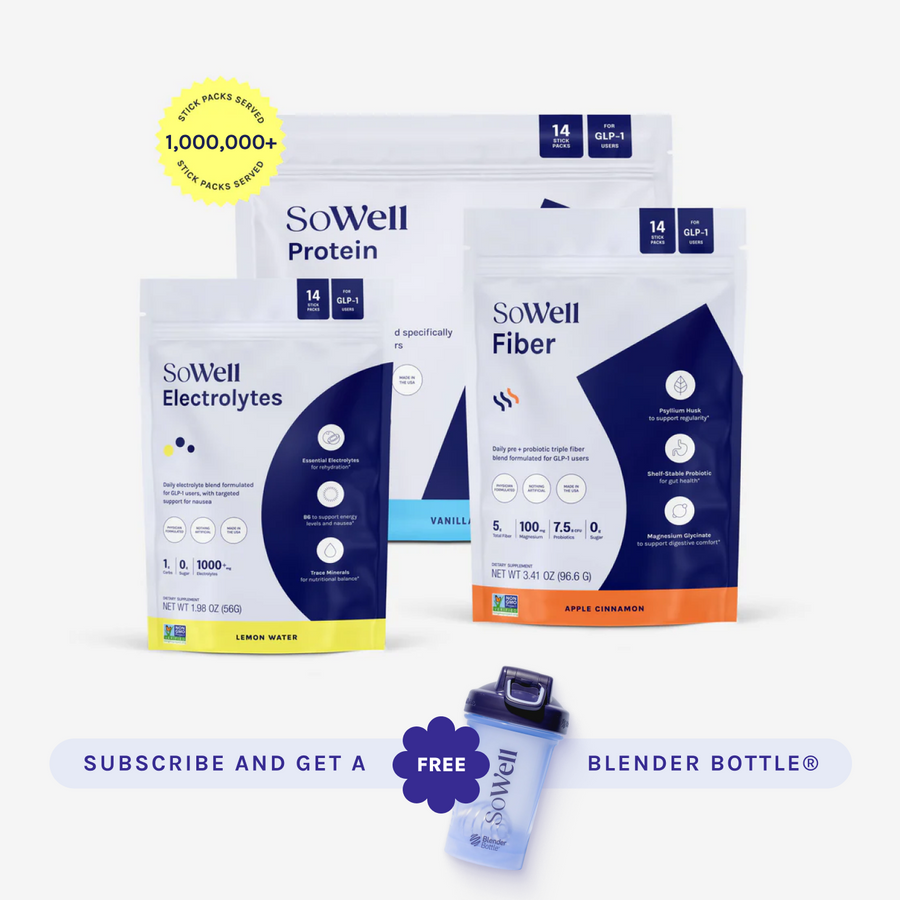
The GLP-1 Support System
4.8 STARS (317 Reviews)

The GLP-1 Support System

NauseaEnergyHydration

All three formulas in a 14-day daily system — designed by a practicing physician specifically for GLP-1 users.

$104.97

$114.97Bundle & Save $20.50

Or start with one product

SoWell Electrolytes
4.8 STARS (114 reviews)

SoWell Electrolytes

NauseaEnergyHydration

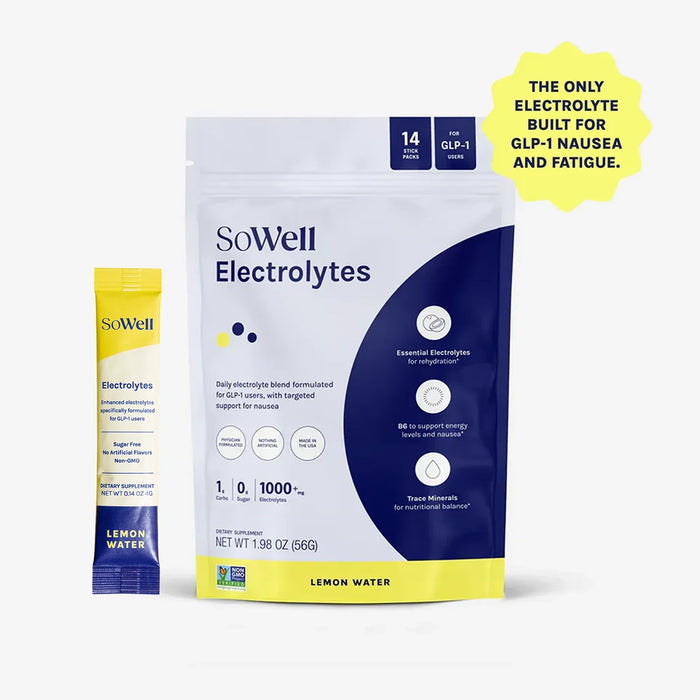
Designed for GLP-1 taste sensitivity. 15mg B6 · 380mg sodium · 0g sugar · Lemon Water.

$34.99

Subscribe & Save $3.50

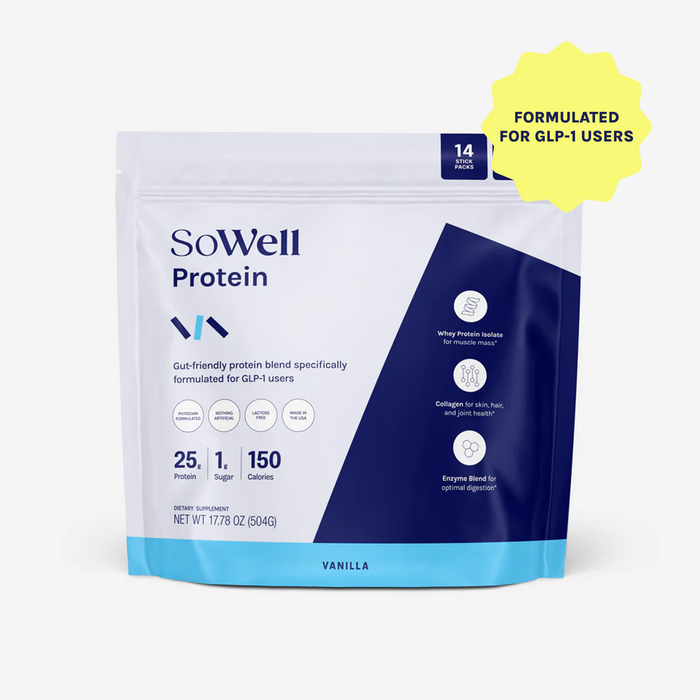
SoWell Protein
4.8 STARS (69 reviews)

SoWell Protein

NauseaEnergyHydration

25g whey isolate + collagen blend. 150 cal · 1g sugar · digestive enzymes · Natural Vanilla.

$44.99

Subscribe & Save $3.50

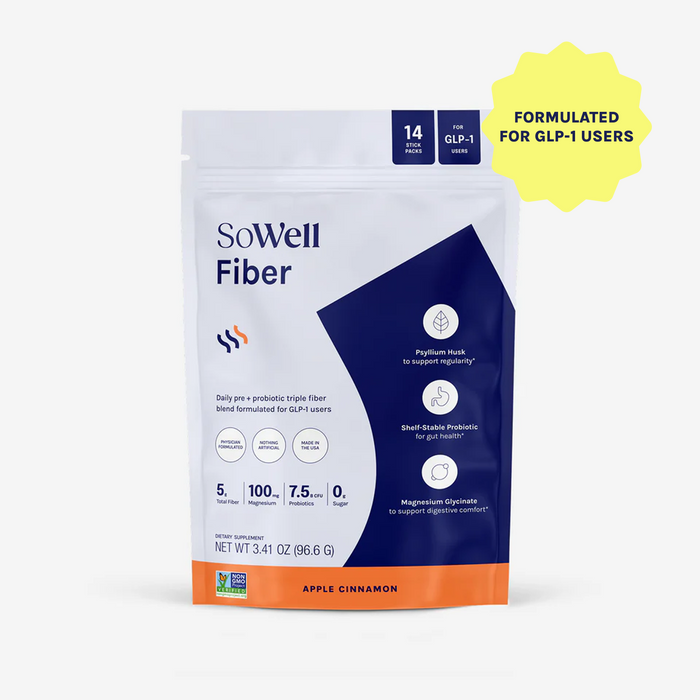
SoWell Fiber
4.9 STARS (51 reviews)

SoWell Fiber

NauseaEnergyHydration

3,100mg psyllium husk + Sporeviva probiotic. 100mg magnesium glycinate · 5 cal · 0g sugar.

$34.99

Subscribe & Save $3.50

Made for GLP-1 Users
Nothing Artificial
Physician Formulated
Family Owned
Made for GLP-1 Users
Nothing Artificial
Physician Formulated
Family Owned
Made for GLP-1 Users
Nothing Artificial
Physician Formulated
Family Owned